Software Architecture
Architecture Shapes Outcomes: DDD vs Layered Architecture in .NET Microservices
7 min read · Suitable for CTOs, architects, and senior engineering teams
In modern .NET microservices, project structure is not a cosmetic decision — it directly affects scalability, maintainability, team autonomy, and long-term cost. Many teams adopt microservices but unknowingly create distributed monoliths, not because microservices fail, but because architectural boundaries are poorly defined.
Two structural approaches dominate most enterprise discussions: traditional layered architecture and Domain-Driven Design (DDD). Choosing between them is an architectural decision that shapes outcomes long before the first line of code is written.
Layered Architecture in .NET: A Familiar Starting Point
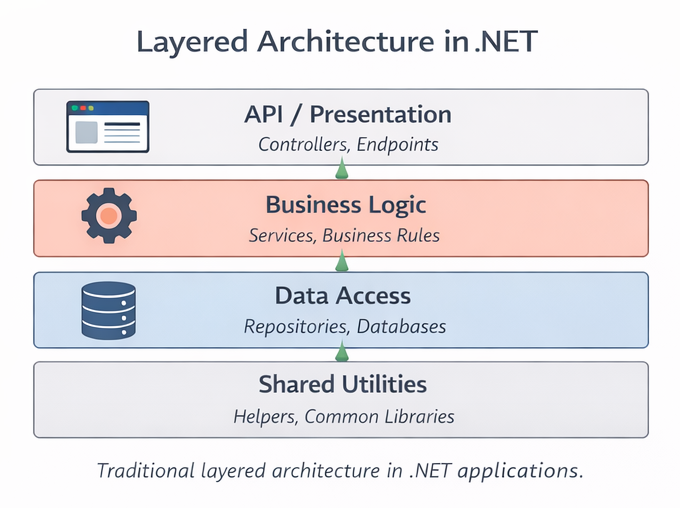
Layered architecture organises code by technical responsibility. A typical ASP.NET application is divided into controllers, business or service layers, data access layers, and shared utilities.
This approach works well for small systems and CRUD-heavy applications. However, as complexity grows, business logic spreads across layers, dependencies increase, and changes ripple through the system.
In microservices environments, this often results in services that appear independent but behave like a monolith — tightly coupled, difficult to evolve, and expensive to maintain.
Domain-Driven Design: Structuring Around the Business
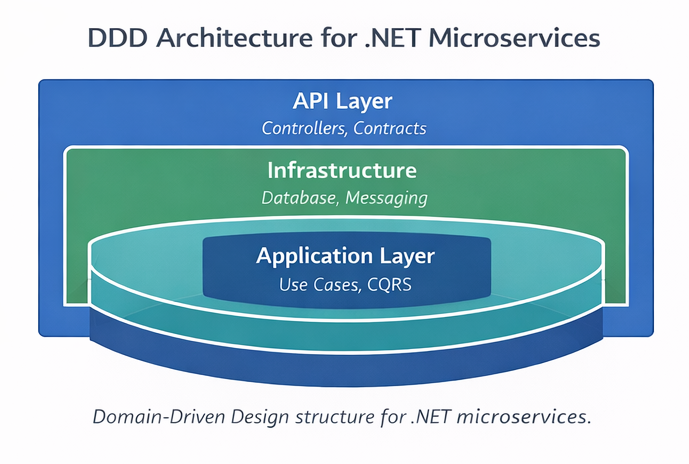
Domain-Driven Design shifts the focus from technical layers to business domains. Code is organised around clearly defined bounded contexts, keeping business rules isolated from infrastructure concerns.
A typical DDD-aligned .NET microservice consists of a Domain layer for core rules, an Application layer for use cases, an Infrastructure layer for persistence and integrations, and a thin API layer.
This structure ensures business logic remains stable while technology choices evolve independently — a critical requirement for long-lived enterprise systems.
DDD vs Layered Architecture: A Practical Comparison

Layered architecture optimises for getting started quickly, while DDD optimises for staying successful as systems and teams scale.
- Scalability: Layered designs struggle beyond a point; DDD is built for growth.
- Change impact: Layered changes ripple widely; DDD keeps impact localised.
- Team autonomy: Layered structures centralise decisions; DDD enables independent teams.
- Testability: DDD promotes isolated, business-focused testing.
.NET Microservices and Architecture Alignment
Modern .NET tooling strongly supports DDD-aligned architectures. ASP.NET Core enables thin APIs, MediatR supports command and query separation, and Clean Architecture enforces dependency inversion.
Combined with containers and event-driven messaging, DDD enables microservices that scale both technically and organisationally — without collapsing into distributed monoliths.
Architecture-First Thinking at Nexvra Technologies
At Nexvra Technologies, we help organisations design .NET microservices with clear service boundaries, strong domain alignment, and long-term sustainability. Our approach is architecture-first — focusing on structure and system health before delivery accelerates.
Conclusion
Project structure is not a developer preference — it is a strategic decision. In .NET microservices, Domain-Driven Design consistently proves more resilient than traditional layered approaches for systems that must scale and endure.